Tuesday, September 1, 2026
CVTC instructor becomes the lesson
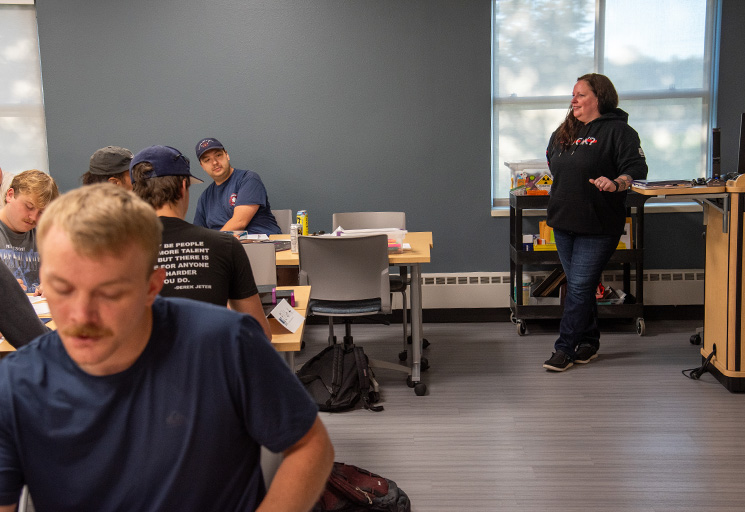
Jen Struensee, Chippewa Valley Technical College EMS instructor, has been teaching at the college for 11 years. As one of the first on the scene of the most horrific 911 call in her career, she tells the story to students to make sure they take care of their mental health as they care for others.
Today, Jen Struensee is teaching EMS hopefuls in her classroom at Chippewa Valley Technical College.
But seven years ago, she was at the height of her career as a firefighter-paramedic when a 911 call changed everything.
She remembers the smells, the sounds, the crisp air, and her knees in the dirt as she performed chest compressions.
She thinks back to her student riding along on her first 911 call, learning in the middle of a tragedy no classroom could replicate.
Struensee lost her patient that day.
She tried to convince herself she was fine. She wasn't.
In the days that followed, she experienced stomach issues, headaches, body aches, the dichotomy of insomnia and an overwhelming desire to sleep. Certain sights, sounds and smells became triggers.
During a crisis intervention debriefing, she was handed a list of post-traumatic stress symptoms.
Struensee believed Post Traumatic Stress Disorder (PTSD) was something that happened to soldiers. She didn't understand how trauma could follow someone home in an ambulance.
The once CVTC student herself sought counseling. She took medication. And she talked publicly and privately to anyone who would listen.
“I felt like talking about mental health helped me deal with my mental health.”
It became her platform.
Now, as an EMS instructor at her alma mater, Struensee talks to her students about being proactive rather than reactive. She asks them what they do when they're stressed. Do they listen to music, go hunting, spend time with their dogs, or ride horses?
Because when she needed those things, she didn't want any of them.
“I wanted to hide in the dark because I didn’t think I was good enough, and I thought I made all these mistakes,” she said.
For the first three years, Struensee cried while telling her students about the call.
Then, one semester, she noticed a student becoming increasingly uncomfortable as she shared her story. When class took a break, the student stayed behind.
She told Struensee she was the sole survivor of that call.
Struensee had no idea.
She had seen Struensee's name in her medical record and wanted to become like the people who had taken care of her.
For Struensee, the moment wasn't about being thanked. It was about realizing how intertwined people's lives can become without either person knowing it.
Struensee doesn't remember every patient she's treated. That's not because she didn't care. It's because she cared for them all.
Now, after nearly 20-plus years in medicine and about 11 years teaching at CVTC, she sees her role differently.
She isn't simply preparing students to become paramedics. She's preparing them to be human in a profession that asks them to witness some of the hardest moments of other people's lives.
“I am a hot mess. I am a good paramedic, I’ve fought the fires, I am a good teacher, but I come with all of this,” she said.
That is what Struensee wants her students to understand.
She wants her students to know that they can be affected by what they see and still do the job. They can ask for help. They can care deeply without carrying everything alone.
“You want to be me?” she said. “This is exactly who I am.”
And sometimes, years later, a student will walk into their classroom and remind them why it all mattered.
“It’s been a beautiful career,” Struensee said. “I feel like I fit here.”